If you’ve ever looked at a T-shirt description and seen 180 GSM, 200 GSM, or 240 GSM, you might have wondered what those numbers actually mean.
So, what is GSM in T-shirts?
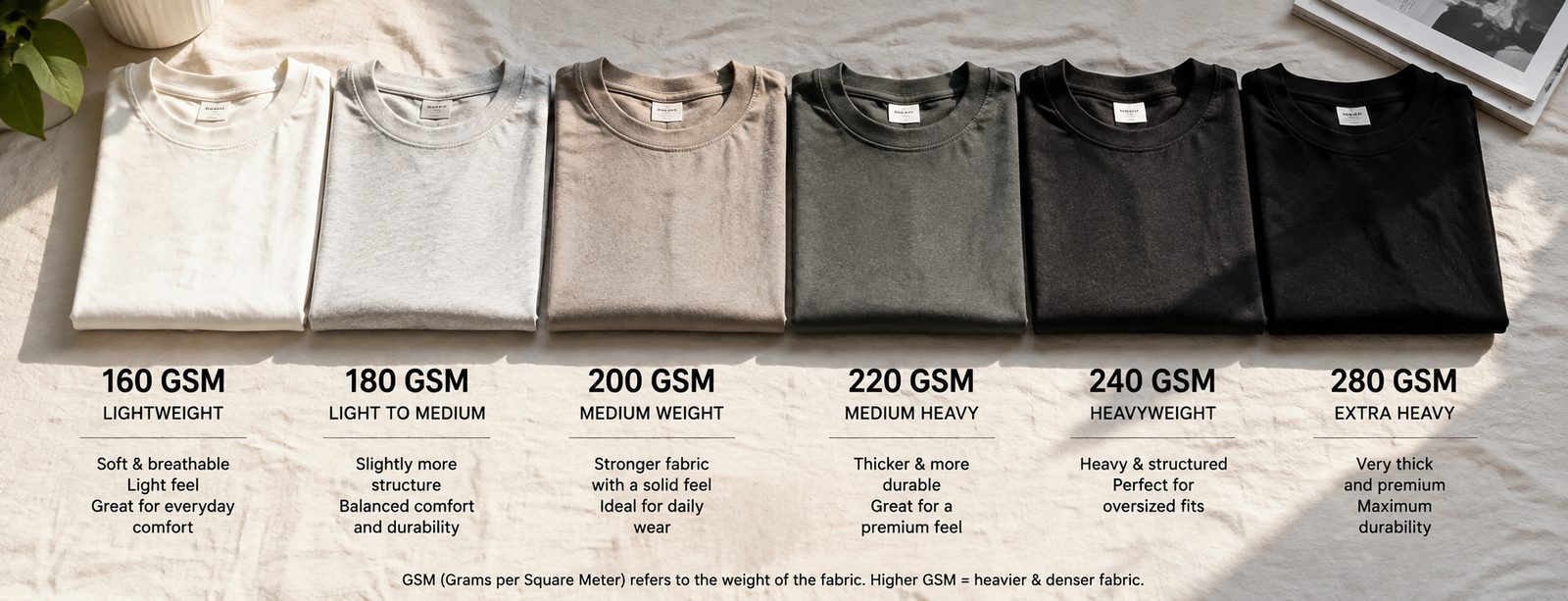
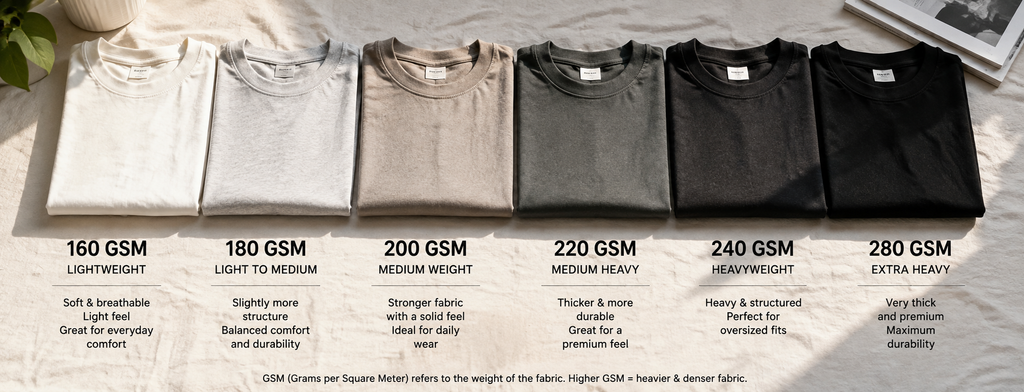
GSM stands for Grams per Square Metre. It is a measurement used to describe the weight of fabric. In simple terms, it tells you how much one square metre of fabric weighs.
GSM can give you a better idea of how a T-shirt may feel, drape, and look when worn. But one thing is important to remember: a higher GSM does not automatically mean better quality.
Let’s break it down.
What Does GSM Mean in T-Shirts?
GSM, or grams per square metre, measures the weight of the fabric rather than the weight of the finished T-shirt.
For example, a 180 GSM fabric weighs approximately 180 grams per square metre, while a 240 GSM fabric weighs approximately 240 grams per square metre.
The difference can be noticeable when you handle the fabric.
A lighter fabric can feel soft and breathable, while a heavier fabric generally feels denser and more substantial.
However, GSM is only one part of the equation. Fibre type, yarn quality, knitting, finishing, and construction can also affect how the final T-shirt feels.
Why Is GSM Important in T-Shirts?
Understanding T-shirt GSM can make shopping online much easier.
Product photos can show you what a T-shirt looks like, but they don’t always tell you how the fabric will feel.
GSM gives you another useful specification to consider.
It can influence:
Fabric weight: Higher GSM generally means a heavier fabric.
Structure: Heavier fabrics can create a more substantial and structured appearance.
Drape: Fabric weight can affect how a T-shirt falls when worn.
Comfort: Lighter fabrics may feel more comfortable in hot conditions, while heavier fabrics can provide a more substantial feel.
Overall appearance: The same T-shirt design can look quite different depending on the weight and construction of the fabric.
This is particularly important when choosing oversized or boxy T-shirts.
T-Shirt GSM Guide: Lightweight to Heavyweight
There isn’t one universal GSM range that every clothing brand follows, but these ranges can give you a general idea.
140–160 GSM: Lightweight
Lightweight T-shirts generally have a thin, breathable feel.
They can be suitable for:
- Hot weather
- Everyday casual wear
- Summer outfits
- People who prefer lightweight fabrics
160–200 GSM: Medium Weight
This range offers a balance between lightness and structure.
A 180 GSM T-shirt, for example, can work well as an everyday basic because it isn’t extremely lightweight or particularly heavy.
200–220 GSM: Mid to Heavyweight
Once you move above 200 GSM, the fabric generally starts feeling more substantial.
This weight can work well for people who want a T-shirt with more structure and body.
220–260+ GSM: Heavyweight
Heavyweight T-shirts have a denser and more substantial feel.
They’re especially popular for oversized T-shirts, boxy fits, and streetwear-inspired clothing.
These ranges are only general guidelines. Two fabrics with the same GSM can still feel different because of differences in fibre, yarn, construction, and finishing.
180 GSM vs 240 GSM T-Shirts
One of the easiest ways to understand GSM is by comparing 180 GSM and 240 GSM.
180 GSM T-Shirt
A 180 GSM T-shirt is relatively lightweight and versatile.
It can be a good option for:
- Everyday wear
- Warm weather
- Casual outfits
- Lightweight layering
It generally has a lighter and less substantial feel compared with heavier fabrics.
240 GSM T-Shirt
A 240 GSM T-shirt is considerably more substantial.
It can work particularly well for:
- Oversized fits
- Boxy silhouettes
- Streetwear
- Structured outfits
- Layering
The additional fabric weight can give the garment a stronger silhouette.
So, when comparing 180 GSM vs 240 GSM, neither is automatically better. They simply offer different characteristics.
Is Higher GSM Better?
Not necessarily.
This is one of the biggest misconceptions about T-shirt fabric.
A 240 GSM T-shirt isn’t automatically better than a 180 GSM T-shirt.
GSM measures fabric weight, not overall quality.
Imagine two T-shirts.
One is 180 GSM but uses good-quality cotton, has clean stitching, and has a well-designed fit.
The other is 240 GSM but has poor construction and an uncomfortable fit.
The heavier T-shirt isn’t automatically the better garment.
When looking for a quality T-shirt, consider the complete picture: fabric composition, yarn, construction, stitching, finishing, fit, and GSM.
What GSM Is Best for Oversized T-Shirts?
If you like oversized clothing, GSM becomes particularly interesting.
An oversized T-shirt has more volume than a regular-fit T-shirt, so the fabric plays an important role in how that volume sits on the body.
A lighter fabric can create a softer and more relaxed drape.
A heavier fabric can create a more structured and boxy appearance.
For this reason, heavyweight oversized T-shirts often use fabrics in the 200–260+ GSM range.
But there isn’t one perfect GSM for every oversized T-shirt.
Your choice should depend on the climate, fit, fabric, and the type of look you want.
What GSM Is Best for Indian Weather?
India has a wide range of climates, so the best GSM can depend on where and when you plan to wear your T-shirt.
For hot and humid conditions, lighter fabrics can be more comfortable for everyday wear.
For cooler weather, indoor environments, or layered outfits, a heavier fabric can make more sense.
This is why there isn’t one best GSM for T-shirts in India.
Instead, think about where you’ll wear the T-shirt and how you want it to feel.
How to Choose the Right T-Shirt GSM
Before buying a T-shirt, ask yourself three simple questions.
1. What weather will I wear it in?
For hot weather, you may prefer a lighter fabric.
2. What fit do I want?
For an oversized or boxy silhouette, a heavier GSM can provide more structure.
3. How do I want the fabric to feel?
If you prefer lightweight and breathable clothing, look toward lower GSM.
If you prefer a solid and substantial feel, consider higher GSM.
The right choice isn’t about finding the biggest number. It’s about finding the fabric weight that suits you.
GSM Isn’t the Whole Story
While GSM is useful, don’t judge a T-shirt by GSM alone.
Fabric quality depends on several factors.
Fibre affects characteristics such as softness and performance.
Yarn affects the way the fabric is constructed.
Knit construction affects its structure and feel.
Finishing can affect the final appearance and texture.
And, of course, fit and construction determine how the finished T-shirt actually looks when worn.
That’s why two T-shirts with the same GSM can still feel completely different.
Final Thoughts
So, what is GSM in T-shirts?
Simply put, GSM means Grams per Square Metre, and it tells you the weight of the fabric.
A lower GSM generally means a lighter fabric, while a higher GSM generally means a heavier and more substantial fabric.
But higher doesn’t automatically mean better.
For an everyday T-shirt, something around 160–200 GSM can offer a lighter feel. For a more structured oversized or heavyweight style, 200 GSM and above may be more suitable.
The important thing is to look at GSM together with fabric, construction, fit, and your own preferences.
At RYOW, we believe good clothing comes down to the details. Fabric weight is just one of them—but once you understand GSM, you can make a much more informed choice about the clothes you wear.